Pacing is a skill, and most athletes never train it
At some point, almost every competitive CrossFit® athlete experiences the same frustration: the workout was within their capacity, but the result didn’t reflect it. Not because they weren’t fit enough, but because they mismanaged their pace. This blog breaks down why pacing isn't instinctive, why intensity alone isn’t enough, and how the best athletes train pacing as a skill—not a feeling.

At some point in every competitive CrossFit® athlete’s career, there comes a hard realization: you were fit enough to do better, but you didn’t.
Not because you lacked strength.
Not because you didn’t want it badly enough.
Not because the movements were outside your capacity.
You simply mismanaged the workout.
This realization often shows up during the Open or Quarterfinals, when athletes walk away saying things like:
- “I went out too hot.”
- “I just lost my breath.”
- “I felt amazing for the first few minutes… and then everything fell apart.”
- “If I could do it again, I’d change my pace.”
The uncomfortable truth is this: pacing is not instinctual. And for most athletes, it is not something they have ever truly trained.
THE MYTH OF “JUST SEND IT”
CrossFit® culture has long celebrated intensity. That is not inherently a bad thing. Intensity is one of the pillars of the methodology, and it is absolutely required for adaptation and progress.
However, somewhere along the way, intensity became confused with recklessness.
Many athletes equate a good workout with how much they suffered, how early they redlined, or how long they held on before the inevitable crash. They pride themselves on being “aggressive” and “fearless,” believing that elite athletes simply turn their brains off and push.
In reality, the best CrossFit® athletes in the world are doing the opposite.
They are thinking. They are controlling. They are restraining themselves — especially early. Pacing is not a lack of effort. Pacing is effort applied intelligently.
WHY MOST ATHLETES FAIL AT PACING
The reason pacing is so poorly executed in competitive CrossFit® is simple: most athletes only experience it by accident. They discover pacing after blowing up.
They learn pacing only after their breathing spirals out of control, their movement degrades, or they are forced into extended rest they never planned on taking. The lesson becomes reactive rather than intentional.
Additionally, athletes are conditioned to chase external feedback:
- Splits on the whiteboard
- Other athletes’ speeds
- Leaderboards and heat placements
This comparison-driven environment pushes athletes to abandon their plan almost immediately. They see someone else moving faster and assume they should be able to match it, regardless of whether it aligns with their own physiology.
At that moment, pacing disappears — replaced by emotion.
PACING IS A SKILL, NOT A FEELING
One of the most damaging beliefs in CrossFit® is that pacing is something you will “feel out” in the moment. High-level athletes know this isn’t true.
Pacing is a skill — just like gymnastics, lifting, or cyclical efficiency. And like any skill, it must be trained deliberately, under controlled conditions, and with feedback.
Elite pacing involves:
- Knowing how fast you can move
- Knowing how fast you should move
- Knowing how much effort you can apply without disrupting breathing
- Knowing when restraint creates a better outcome than aggression
Most athletes only train the first item on that list.
THE FIRST 3 MINUTES DECIDE THE WORKOUT
In most Open- and Quarterfinal-style workouts, the outcome is largely determined early — not late.
The initial minutes dictate:
- Breathing trajectory
- Heart rate drift
- Movement quality under fatigue
- The length and frequency of rest later
Athletes who spike intensity early create a metabolic problem they cannot solve later, no matter how mentally tough they are.
Conversely, athletes who appear “slower” at the start often maintain rhythm, composure, and technical consistency — allowing them to close stronger while others unravel. This is not accidental; it is rehearsed restraint.
TRAINING HARD ≠ TRAINING PACING
Many athletes believe that because they train hard every day, they are preparing themselves to pace well in competition. This is a mistake – training hard develops capacity, but training with intent develops execution.
If every training session is treated like a competition, athletes never practice:
- Backing off intentionally
- Holding submaximal output
- Executing a plan independent of external pressure
These athletes become excellent at surviving chaos, but poor at controlling it.
Ironically, the athletes who appear the calmest and most composed on the competition floor are often the ones who have spent the most time training below their absolute ceiling — learning exactly where that ceiling is.
WHAT ELITE PACING ACTUALLY LOOKS LIKE
Elite pacing is rarely flashy. It looks like:
- Breathing that never fully spirals
- Movement that stays repeatable
- Transitions that are deliberate, not rushed
- Rest that is intentional and short — not desperate and long
These athletes are not guessing. They are executing a plan they trust. And when something goes wrong — a missed rep, a no-rep, a stumble — they do not panic. Their system is not already maxed out, so they have room to adapt.
This is the difference between competing and surviving.
QUALITY-DRIVEN ATHLETES PACE BETTER
A quality-driven athlete evaluates a workout based on:
- Was the plan executed?
- Was breathing controlled?
- Was movement quality maintained?
- Were rest intervals intentional?
A comparison-driven athlete evaluates a workout based on:
- Who finished first
- Who moved faster early
- What the leaderboard says
The irony is that quality-driven athletes often outperform comparison-driven athletes in competition — because they are not emotionally hijacked by others' performance.
They are competing against the workout, not the room.
A CHALLENGE MOVING FORWARD
As you move into your next training cycle — whether you are transitioning out of the season or building toward the next one — challenge yourself to rethink how you define intensity.
Ask yourself:
- Can I hold back on purpose?
- Can I execute a pace that feels “too easy” early?
- Can I finish a workout knowing I never panicked?
True competitiveness is not about who is willing to suffer the most. It is about who can apply the right amount of effort, at the right time, for the longest duration.
Pacing is not passive. It is disciplined aggression.
And like any skill worth mastering, it takes patience, awareness, and practice.
Train it accordingly.


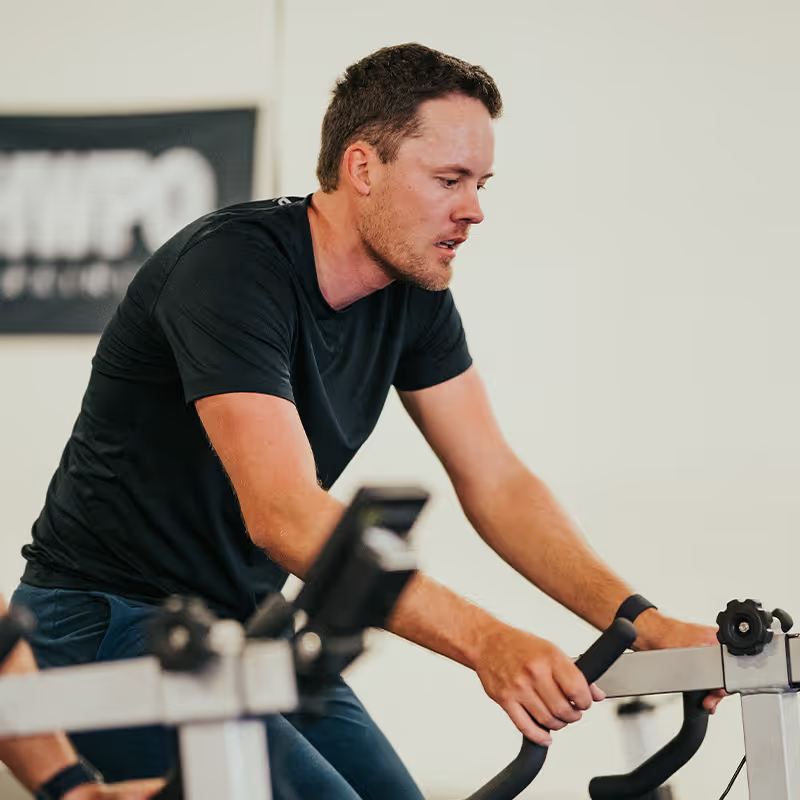
Learn how to pace workouts properly
HWPO programs are built to develop more than fitness — they teach execution. With structured training, clear daily intent, and controlled exposure to intensity, you learn when to push, when to hold back, and how to apply effort intelligently across a workout.