What I've Learned Coaching Patrick Vellner Over The Years
In this article, HWPO AFFILIATE Head Coach Michele reflects on nearly a decade of coaching Patrick Vellner through one of the most successful careers in CrossFit®. From building strength and work capacity to adapting training around setbacks, injuries, and life outside the gym, this is a look at the lessons learned through long-term athlete development and an evolving coach-athlete relationship.
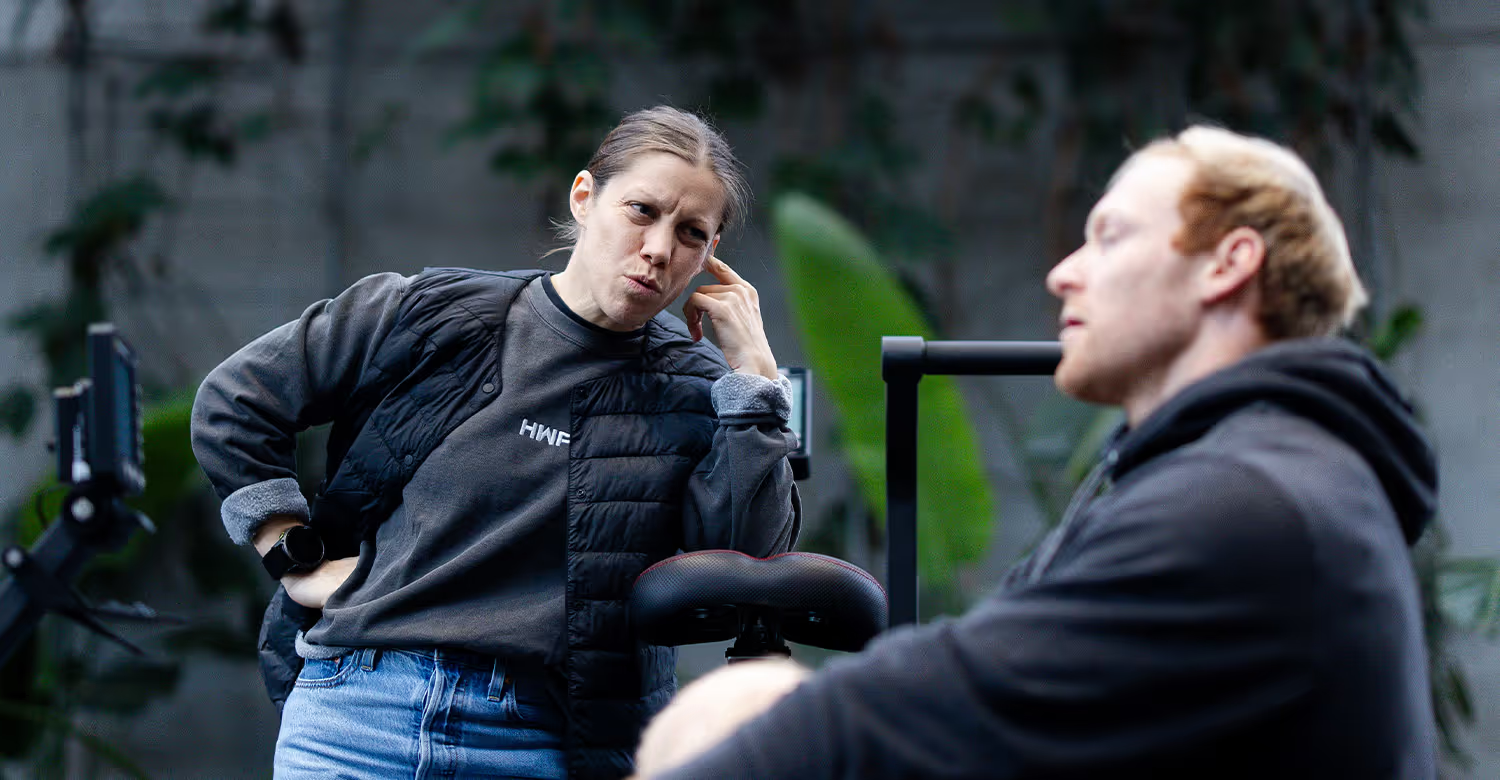
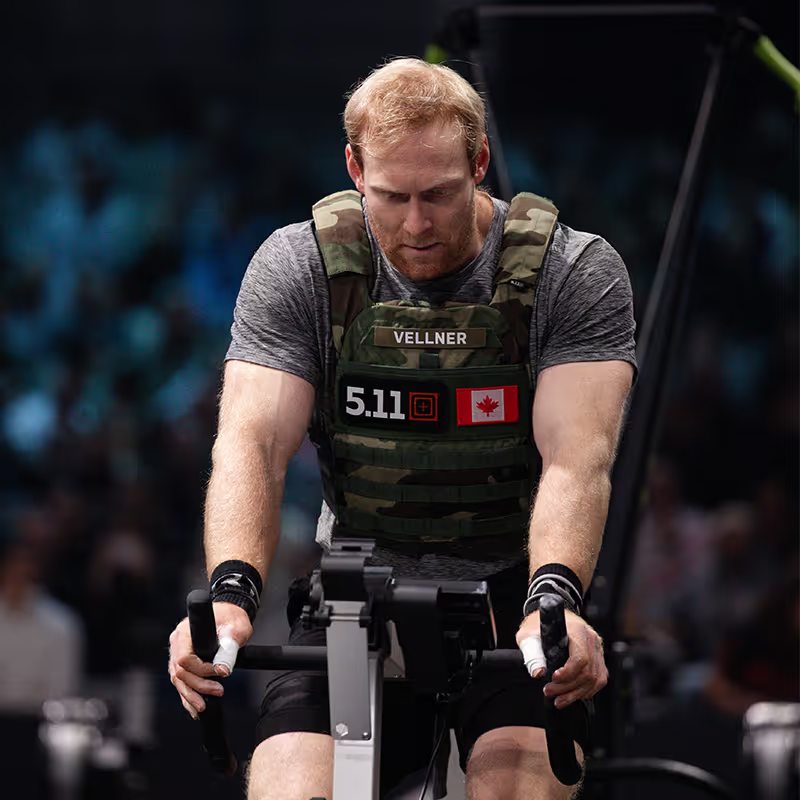
This year, Patrick Vellner announced that he was retiring from competition, aiming to qualify for his 10th CrossFit Games and wrapping up one hell of a career. I’m not going to lie, I’m so happy he’s going to be retiring and enjoying his life with his wife and kids. Being a professional athlete is no joke, and he deserves a bit of calmness in his life… Although I don’t believe he’s capable of it. Probably the ONE THING I don’t believe he’s capable of.
Our beginnings
Patrick and I have been working together since the 2017 season. Before that, we were training partners for my last year competing in 2016, and we met way back in 2014 (or was it 2015?).
We met through competition, but mainly because he lived and trained at McGill University in Montreal while I worked and trained at CrossFit Plateau, a gym right near the campus. When Pat qualified for his first individual CrossFit Games in 2016, circumstances had him actually moving in with my boyfriend and me for the summer while we were both training for the Games.
Later that year, I planned to launch a coaching platform and asked him if he’d be interested in working with me; he agreed. He was my first ever athlete, and I had my work cut out for me since he finished 3rd in his FIRST YEAR. He gave me a chance, so I was going to do everything I could to make sure he would continue to thrive.
I’ve had many coaches over the years, and I had a very good sense of how I wanted to do things. I saw firsthand what worked well, and I had many ideas I wanted to try out.
My goal with this article is to share what I’ve learned over the years, but it’s important to note that not everyone is the same, and this isn’t a recipe. The goal here is to demonstrate how coaches learn over the years of working with people and how the coach-athlete relationship can be very different. In this case, I really think Pat and I’s relationship is quite unique. I truly saw us as colleagues or peers, working towards a goal, but with different roles.
How training started: strength & volume.
When Pat and I started working together, we needed to get him stronger. He had the capacity to podium with strength numbers that weren’t high enough to be consistent, so it was our number 1 priority. As he was training for his second year at the games, I was diving into a lot of coaching education and competing in Olympic Weightlifting, so I was all in on strength work. We used both linear progressions and undulating formats to increase his strength, and we also increased his volume from what he had been doing.
To help manage the intensity of the strength work, we often compartmentalized the training days as barbell days & bodyweight or light days. When he was doing a lot of strength work, I made sure that the following day would be light & mostly gymnastics-based.
We kept doing lots of conditioning: couplets, triplets, intervals and aerobic work, but most of the time we were working on his strength. And it worked really well; he finished 3rd (again) as an individual in his second year at the CrossFit Games.
The following year, we kept doing what we were doing, but we put a bit more emphasis on volume. We kept the days identified as barbell days and or light/gymnastics days, but we aimed to increase his work capacity by adding more sessions and increasing volume on specific movement patterns. Example: pressing days would have pressing in 2-3 sections, starting with the highest range of motion and ending with the shortest and fastest range of motion. So not only were we trying to increase his strength, but also his muscular endurance.
We kept working this way for the first 3-4 years: year 1 focused on higher intensity and increasing strength; year 2 focused on increasing his strength endurance; then back to trying to increase his absolute strength, and more specifically, his overhead pressing. Then in year 4, Pat hit a little bit of a setback.
A turning point
2019 was a tough year. By now, Pat had accumulated 3 consecutive years of podium finishes. There was a lot of confidence racked up, but training had felt a bit stagnant and frustrating. This was exacerbated by the CrossFit Games announcing numerous changes that would completely redefine the Games season (again). Needless to say, something was off. We went into the 2019 CrossFit Games with the goal of winning and giving Mat a run for his money. In the first event, Pat tried to make a statement and came so very close, but unfortunately, he suffered a heat injury and couldn’t turn it around. He got cut from the competition and finished in 16th.
Then in 2020, Covid-19 happened, and that season was a tough one for reasons completely beyond our control, in addition to nursing a few injuries that were becoming consistent and pretty nagging.
As a coach, I took these 2 years as a red flag and knew that we had to change things up.
Contrast training & managing intensity
In 2020, my personal interest shifted toward endurance sports, and I was reading a TON about different ways to train aerobic endurance. There were some really interesting concepts that align with the strength training methods I used a lot with Pat, such as the conjugate method. I was starting to learn about contrast training.
I asked Pat, “I have an idea of how we can move forward. I’ve never tried it before. Would you be willing to try it with me?” And his answer was yes.
We started contrasting his training by having high-volume, low-intensity days and low-volume, high-intensity days. This would help manage the impacts of high-intensity training and, at the same time, increase his work capacity, with clear instructions to focus exclusively on getting the work done, with no clocks and no urgency. It also gave him a mental break; he knew how to manage his training.
Since then, we’ve been consistently re-evaluating training and adjusting not just for an ageing athlete’s body but for changes in Pat’s life. Finishing school, having their first baby, then a second, we’ve consistently adapted training to make sure he could stay on top of both his life and professional priorities.
The contrast training approach was a huge win for us in both results and in understanding how training can change without constantly adding more; it gave us a new perspective on dosing and what constitutes effective training. I wouldn’t have thought 10 years ago that doing high-volume workouts with no performance goal other than hitting 200+ reps of the movement would increase work capacity and resilience, but turns out the benefits were huge.
We also have to address that this method was particularly effective for Pat because of his accumulated fitness. Pat had 4 years of individual CrossFit + MANY YEARS of other fitness, so Pat had the maturity level to actually apply this training properly. When I told him that the intensity is low, he did it.
What I’ve learned over the years
So here, after all this, are the things that I’ve learned:
- Strength is VERY important for competitors; it’s a non-negotiable. But one thing I didn’t realize is how much confidence plays in that. Strength gives athletes confidence that can give them a huge advantage in competition.
- It’s MUCH harder to stay at the top than to rise to it. Looking up gives you a clear path. At the top, you have a 360-degree view, so there are a lot of distractions & a sense of accomplishment. It takes a whole lot of discipline and attention to detail when you’re at the top.
- Coaches: It is crucial to try new things. Be honest with your athletes when you do, explain why you want to try it and why you think this would be a good approach.
- Volume and Intensity are NOT in competition. Intensity isn’t everything, and volume isn’t the devil. In endurance sport, volume is used to increase aerobic capacity AND increase movement mechanics WITHOUT the mechanical breakdown that comes with intensity. When high volume is used well, we can get athletes to include A LOT OF HIGH QUALITY REPS and help athletes resist mechanical breakdown when we get into higher intensity. This is WHY athletes at the games look so good even at high intensity. I strongly believe that intensity is important, but not something we can include/tolerate every day.
- A champion mindset isn’t always loud and inspirational. Winners are amazing, they are exceptional and often have a different set of skills than most, but they’re NOT ALL the same. I’d argue that people who fall short of their goals and consistently fight for them develop mindsets, mental tactics, and ideas that are truly valuable to everyone.
- Creativity in sport is way more important than people think, especially if your sport is “the known and the unknowable”.
Bring expert coaching principles into your gym
Great coaching is about more than writing workouts. It is about understanding how athletes develop, adapting training over time, and building systems that create long-term progress. HWPO AFFILIATE gives you the tools to achieve exactly that.